


Proper exercise bike maintenance is essential after many hours of use, so that it is always completely efficient and you can fully use it whenever you like. Exercise bikes are only seemingly simple fitness equipment, but a closer look reveals that they are a complex set of respectable mechanisms and electronics. In practice, the action on the pedals rotates a pulley (enclosed, like the rest of the mechanism, in a housing closed by a casing), which transmits the motion to a heavy flywheel.
Its rotation can be gradually “braked” by a magnetic (or electromagnetic) device consisting of permanent magnets that are approached or moved away from the flywheel, depending on the setting given on the control console. An electronic card presides over the various controls and provides the console with useful information for those who are using the bike.
Although it is a robust machine that is not affected by particular mechanical stressors, exercise bikes also require routine and sometimes extraordinary maintenance.
WHAT YOU’LL NEED
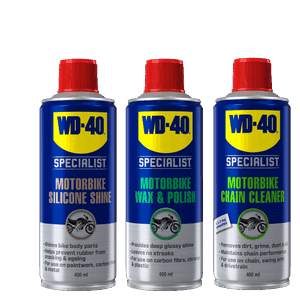
- WD-40 Specialist Bike Cleaner
- Microfibre cloth
- Screwdriver
- Allen wrenches
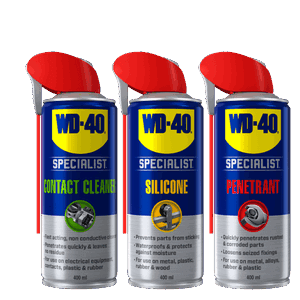
- WD-40 Specialist High Performance PTFE Lubricant
- New bike belt
- WD-40 Multi-Use with Flexible Straw
- Vacuum extractor
EXERCISE BIKE MAINTENANCE, REGULAR CLEANING
Although exercise bikes are usually placed in rooms with excellent environmental characteristics, dust and other disturbing elements may still be present and therefore the bike’s frequent maintenance is required. One of the most significant disturbing elements is the sweat emitted by those who use the bike, which slowly deposits salts and grease on the external structure. For this reason it is best to periodically thoroughly clean the bike, eliminating dust and washing its entire exterior with water and WD-40 Specialist Bike Cleaner, completely drying the bike afterwards.
OPENING THE CASING AND INSPECTION
Even if the bike easily moves and adjusts, it is good practice for proper bike maintenance to open the casing and inspect the internal mechanism at least once a year (but this also depends on the frequency of use). First remove the pedals using the screws or bolts, which secure them to the axis (left rotation for the right pedal and right rotation for the left pedal). Then loosen the locking screws and remove the casing panels. The interior must be vacuumed to remove any dust and other foreign elements.
CHECKS AND LUBRICATIONS
The operating mechanism starts from the pedal axis, the pulley and the belt that drives the flywheel. First check the motion drive belt: it must be intact and tight. You can tighten it with a belt tensioner with a roller, driven by an arm equipped with a spring. On each rotating or moving element, it’s best to spray some WD-40 Specialist High Performance PTFE Lubricant, which provides excellent lubrication and protection and reduces friction and wear, extending the entire bike’s duration. It can be applied to all metals, glass, rubber and plastic.
EVENTUAL BELT REPLACEMENT
If the belt is cracked or partially torn, replace it with a new one. Usually the nuts securing the flywheel axis must be loosened, then the belt can be removed after sliding it away from the pulley. Then you can insert the new belt by positioning it correctly on the belt tensioner, and then replace the flywheel, on whose side crown the new belt is placed.
STEP 5: FLYWHEEL MAGNET DISTANCE CHECK
If possible, check the adjustment of the distance between the magnets that change the resistance of the flywheel, as well as the flywheel itself. Once the bike is started, make any necessary adjustments (with the appropriate knob or through the console display). If possible, apply some WD-40 Multi-Use to the magnet movement system. In this specific case it may be useful to use the product with the flexible straw, which has a dispenser that can be shaped as desired to reach difficult places.
CLOSING THE CASING AND LUBRICATING THE EXTERIOR
After closing the casing and reassembling the pedals, the last maintenance step to be carried out is lubricating the connections of the various sections of the bike with WD-40 Multi-Use: the handlebar adjustment, the saddle and joints and hinges of the structure, so that you can disassemble it and reassemble it easily if you need to move it. At this stage don’t forget to replace (or recharge) the battery that powers the electronic control circuit.
To follow all the news of WD-40 Africa, follow us on Facebook and Instagram !

