


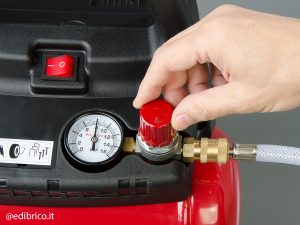
Accurate compressor maintenance is essential for keeping this important tool fully efficient, as it is very useful in different situations. A compressor has three fundamental components: the actual compressor block, formed by a cylinder with a piston driven by an electric motor, the compressed air tank and the dispensing and control unit. The internal pressure of the compressor can be detected by means of a special pressure gauge. The best models are equipped with two pressure gauges: one indicating the pressure inside the tank, the other at the outlet. This can be adjusted by means of a special knob depending on the air demand. The capacity of the tank (6, 24, 100 litres and more) determines the available air reserve. Compressors with a 24 litre tank are very common, as they are suitable for medium use. The weight of this class of compressors ranges between 15 and 30 kg and its overall dimensions can be comparable to that of a medium-sized suitcase. It is robust and durable, but careful maintenance is very important for proper operation. The compressor’s external structure must be periodically cleaned with a generous blow of compressed air, while the wheels that allow it to move should be lubricated with WD-40 Multi-Use.
WHAT YOU’LL NEED
- WD-40 Multi-Use
- Compressed air
- Multigrade Oil
CHECKING AND CLEANING THE AIR FILTER
The compressor compresses air it draws from the environment. Since there may be dust in the air that can damage the compressor unit, the appliance is equipped with an inlet filter. For effective compressor maintenance, periodically open the filter container and extract the filter. Usually the filter element is cleaned by blowing compressed air on it or washing it. If, on the other hand, it appears too clogged or torn, it must be replaced.
CHECKING AND TOPPING UP THE OIL LEVEL
The piston that performs the compression and the moving parts are constantly lubricated with special oil located in the appropriate tank. The cap of the tank has a rod that lets you see the amount present. If it is scarce, add more oil. The best lubricant to use is recommended by the various manufacturers. Generally, multigrade automotive oils are good for compressor maintenance. If it appears too dark, dirty and/or dense, change it completely. This check must necessarily be performed after the first 100 hours of operation. Subsequently, perform the check every 50 hours of use.
CONDENSATE DRAIN
Air compression inevitably forms condensation that collects at the bottom of the tank. At least once every three months, the condensate must be drained using the appropriate screw valve located below the tank itself. This is very important, because allowing liquid to form in the tank can create internal oxidation phenomena that can seriously affect the walls of the tank itself in the long run. Sometimes the valve is slightly oxidized and resists unscrewing, so it’s best to apply WD-40 Multi-Use to unscrew it. This must be done with the tank completely empty.
CHECKING THE PRESSURE SWITCH
The pressure switch is the tank’s internal pressure control element: when the pressure reaches the preset level, the pressure switch closes the power supply and the motor stops. When the pressure drops after use, the pressure switch restarts the motor. Periodically check it by looking at the pressure gauge when it switches off and on, and at the pressures indicated in the operation and maintenance manual. If these values are not respected, the maximum pressure (which causes shutdown) can be adjusted by acting on a screw located inside the pressure switch casing, which can be reached by removing the casing itself.
CHECKING THE OUTLET AIR REGULATOR
The valve that regulates the outlet air pressure is equipped with a pressure gauge and a knob that allows adjustment. To check its efficiency, first completely close it: the pressure gauge must indicate zero bar. Then adjust it to the maximum opening: the pressure gauge must indicate the same pressure indicated by the pressure gauge of the pressure switch. If these indications are different, the valve must be completely replaced. Those who are more experienced can try to disassemble it and treat the internal components with WD-40 Multi-Use.
COMPRESSED AIR TOOLS
These tools (guns, inflation nozzles and more) have a “quick attachment” to the air supply hose. This requires some internal lubrication: in general (unless otherwise indicated by the manufacturer) the minimum amount of oil that the compressed air carries with it is sufficient, using the lubrication oil of the compressor mechanisms. However, it’s best to periodically lubricate any screw and coupling connections with WD-40 Multi-Use, which keeps them clean and also protects them from oxidation. Before turning on tools that have been inactive for a long time, it’s also best to always internally lubricate them with WD-40 Multi-Use.
To follow all the news of WD-40 Africa, follow us on Facebook and Instagram !

