


Car trailers come in two different types, which we often confuse. These are “tow trailers” and “trailers” proper. While the former do not have their own number plate (just a copy of the car’s number plate) and have to be coupled to a specific car, the latter have their own number plate and can be towed by different cars. The two types also have different load capacities. In practice they perform very similar services, so, like all wheeled vehicles, they suffer wear and tear resulting from both the road conditions and the natural ageing of various mechanisms and services.
This is why it is in our interest (and is also our duty) to carry out regular and constant maintenance of the parts of the car trailer that are exposed to the most stress and wear, in order to guarantee the vehicle a high level of functionality that translates into excellent service and a high level of safety. As of 2018, trailers with a maximum overall weight of 3,500 kg must be inspected in compliance with the same deadlines as cars, motorbikes and mopeds: four years after first registration and every two years thereafter.
THINGS YOU WILL NEED
- Screwdriver
- WD-40 White lithium grease
- Set of spanners
- WD-40 Brake cleaner
- Compressor
- WD-40 Fast drying contact cleaner
BRAKE MAINTENANCE
Check the condition of the feru (ferules) and, if necessary, adjust the stroke or replace them. If the stroke of the friction linings has to be restored because they are too far from the disc, it is necessary (using the adjuster on the brake disc plate) to bring the friction linings into gentle contact with the disc. Slight rubbing should be felt when turning the wheel by hand in the direction of travel. Repeat the operation on all the wheels of the trailer. Then press the handbrake lever repeatedly to help centre the brake blocks, releasing the adjuster until the wheels turn without rubbing against the brake blocks. It is advisable to treat the brakes regularly with WD-40 Specialist Brake Cleaner to remove dust and dirt. Its fast-acting formula dries in minutes without leaving any residue.
DAMPER MAINTENANCE
The damper is essential because, besides connecting to the tow bar, it cushions the jolts that develop between the car and trailer when braking and starting. Dampers are often equipped with special grease nipples through which grease can be pumped into the damping system using a manual or compressed air pump. Every part must be lubricated with WD-40 Specialist White Lithium Grease, which provides long-lasting lubrication. It doesn’t run and it clings to the support. It reduces the friction coefficient and facilitates the operation of moving metal parts.
CHECKING AND MAINTENANCE OF THE ELECTRICAL WIRING
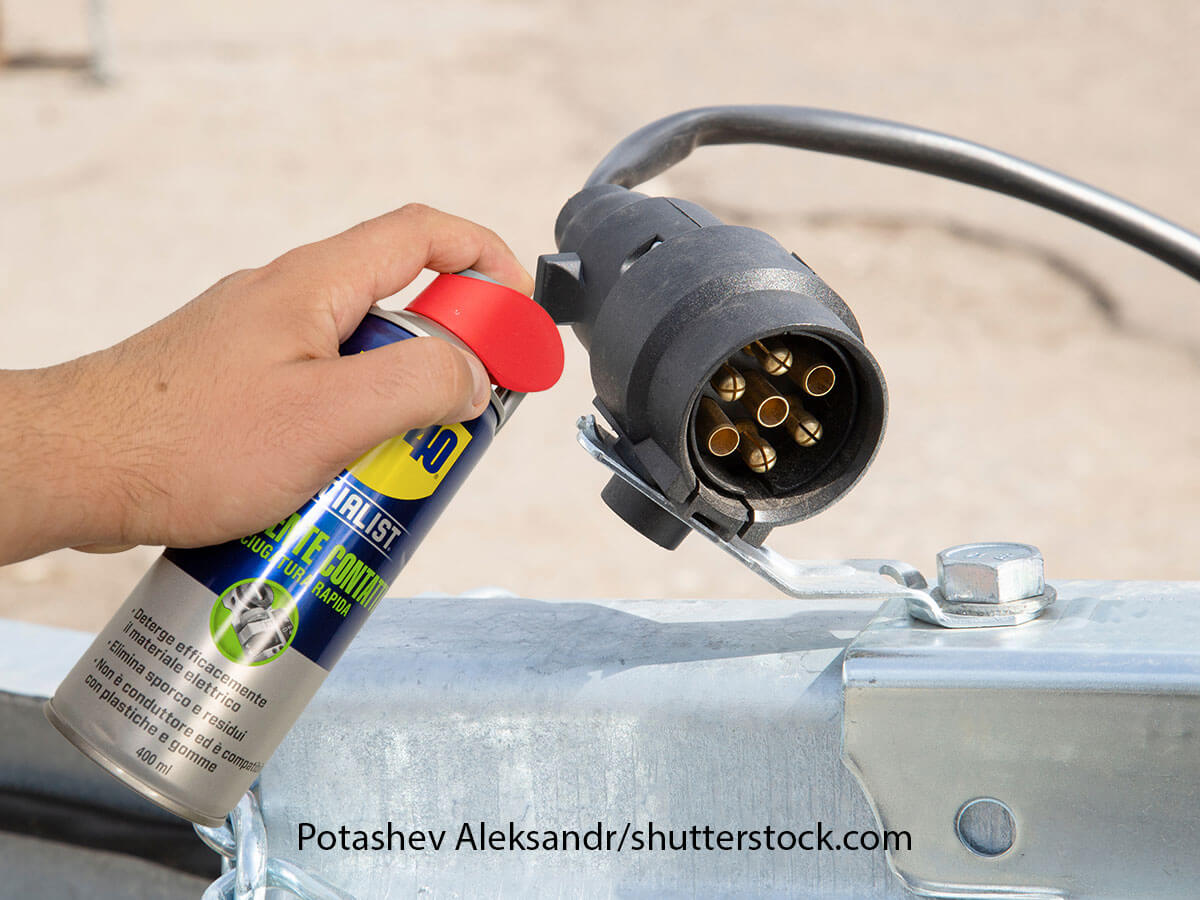
It is advisable to check the integrity of the electrical wiring regularly and make sure that the electrical contacts of the plug and the lights are not oxidised. It is necessary to check that all the signalling components work properly: sidelights, indicators, brake lights and fog lights. Starting with the connector located on the damper, the electrical contacts are subject to aggression from external agents. So, it is a good idea to treat the connector (7 or 13-pole) and the bulb sockets with WD-40 Contact Cleaner, which protects them from oxidation and ensures the best electrical conductivity.
CHECKING AND MAINTENANCE OF WHEELS AND TYRES
Before each journey it is a good idea to check that the bolts that hold the wheels in place are securely tightened and that the tyres are inflated correctly. The pressure should be checked when the tyres are cold. Check the thickness of the tyre tread regularly, using the indicators on the tread. Hard braking with the wheels locked or long journeys at high speed when the trailer is overloaded can damage the tyres and cause abnormal wear. Tyres also age if used infrequently or not at all. Worn tyres increase the risk of skidding, so check the integrity of your tyres regularly (no cracks, cuts on the side, bulges or irregular wear of the tread).
LUBRICATION AND STORAGE
If the vehicle has been exposed to salt spray or has come into contact with sea water, thoroughly wash all parts, especially the braking system, with fresh water before carrying out any lubrication work using the various WD-40 lubricants. Check cold galvanised parts (signalling tubes, various accessories, bolts, etc.) and painted parts (wheel rims, etc.) regularly for rust. If the trailer is going to be placed in storage, do not apply the handbrake and, if possible, keep the trailer raised so that the tyres are not resting on the ground.
To follow all the news of WD-40 Africa, follow us on Facebook and Instagram !

