


Your car’s tyres should be cleaned much more frequently than you think, also because more attention is often paid to the body, engine and interior of the car, than to the tyres. Yet as we all know, they are significantly stressed during use and come into contact with all types of material: from mud to snow, from asphalt to oils and greases. The wheel’s two main components, tyre and rim, must instead be carefully cared for and cleaned in order to preserve its best operation and lengthen its life. Other substances that come from the progressive consumption of brake pads are also deposited on the rims, which are greatly brought into contact with the rotating brake discs while driving. Furthermore, grease resulting from the dispersion of oils from the engines and transmission systems of cars on the road is also deposited on the rims. These oils are also suspended in waste products. When these greasy materials mix with water, they form special emulsions, the so-called pasty “sludges” that are very difficult to remove once they dry.
WHAT YOU’LL NEED
- WD-40 Specialist Universal Cleaner
- Brush
- High-pressure washer
- Microfiber cloth
- Paper towels
- Tyre Blackener – Polisher
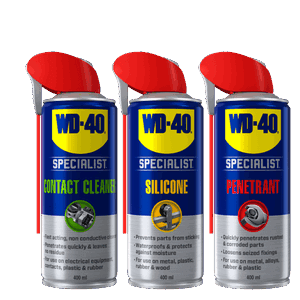
- WD-40 Specialist Fact-Acting Degreaser
CAREFUL EXAMINATION OF THE WHEEL
The first maintenance step in cleaning your car’s wheels is a careful and somewhat picky examination of the tread and sides of the tyre. Different materials (such as pebbles, etc.) and any bodies embedded in the tread must be found and removed. Instead, the sides (internal and external) must be examined for cracks or swelling, indicating dangerous deterioration. If you find either of the above, you must visit your tyre dealer. Also check the balancing lead by checking that they are firmly on the rim, and make sure the inflation valves all have their caps.
WASHING THE TYRES
Use WD-40 Specialist Universal Cleaner and a brush with bristles of medium stiffness to clean the wheels. After wetting the wheel well, apply the detergent to the tyres and wheels with the brush, after diluting it with water in a bucket. Pass over the slits several times, where the fine dust produced by the brake pads is present. After a first rinse, go over any poorly cleaned points with detergent. Then do a final rinse.
WASHING THE RIMS
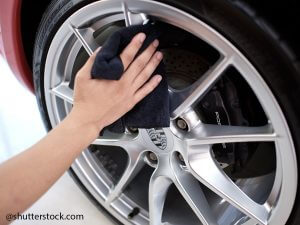
Both iron and alloy rims should be washed a bit more aggressively; the best thing to do is use a high-pressure washer. WD-40 Specialist Universal Cleaner must be applied to the rim by spraying or with a brush. Leave it to act for a few minutes and then spray again and brush to remove the dirt. A high-pressure washer and an appropriate detergent offer the best result.
DEGREASING THE RIMS
A normal washing may not be enough to eliminate grease stains and oily deposits, which must be treated differently. After washing with detergent, and then rinsing, it’s best to apply WD-40 Specialist Fast Acting Degreaser. It is a solvent-based formula that quickly removes grease, oil and dirt without leaving any residue. It acts immediately on contact, and is easy to rinse. The product is available, just like the other products of the WD-40 range, with the “Double Position” system, which lets you switch from a large spray to a precise application in a single gesture. It also offers excellent results on engines and nautical equipment. After application, it’s best to wipe both the treated parts and the entire surface of the rim clean. Finally, we suggest repeating the final wash with another detergent and applying a polishing product for rims.
FINAL TYRE TREATMENT
Once the tyres and rims have been degreased and washed well, dry everything thoroughly with a microfiber cloth and paper towels. Then it’s best to clean the car wheels by applying a blackening/polishing product using the applicator supplied with the product, which may be liquid or a spray. This last step gives the tyre a look similar to when it was new and protects it from a number of potentially harmful elements.
TYRE STORAGE
When replacing winter/summer tyres or vice versa, it’s best to “put them away” perfectly cleaned of any foreign material. Before doing so, it’s also best to have your tyre dealer examine the inside of the tyre for defects or other signs of deterioration.
To follow all the news of WD-40 Africa, follow us on Facebook and Instagram !

