


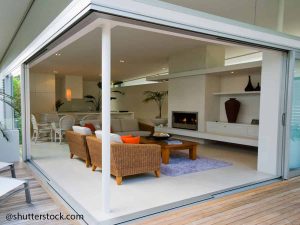
Sliding doors, accordion doors and overhead doors are undoubtedly very practical: unlike doors with hinges, they do not take up any surface area when opening and closing and let us use the available space more easily and completely. On the other hand, sliding doors and windows have more complex and even more delicate operating systems than the simple “hinges” of a standard door. This is why they require more careful maintenance on a regular basis (at least once a year). Sliding doors move laterally by inserting and disappearing into a metal “shell” inserted into a side wall. Their sliding is permitted by special rollers (usually two) equipped with wheels. The rollers are located at the top of the door and run along a special track attached to the door frame. In some cases when the door is considerably wide, there may also be a pin (also with a wheel) located at the bottom of the door, which runs along a hollow track embedded in the floor. This track ensures the door doesn’t “wiggle” during operation.
What you’ll need
- Screwdriver
- Vacuum cleaner
- Long-Lasting Grease Spray
- Blotting paper
- Fast-Acting Degreaser
Step 1: Grease the door tracks
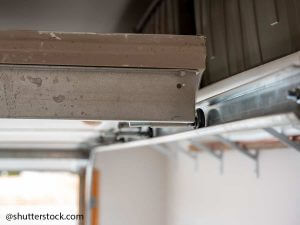
The upper roller and its relative door track must be inspected, cleaned and lubricated and perhaps also adjusted. To access this mechanism, remove (using a screwdriver) the upper covers of the door on both sides, which hide the sliding system. Use a vacuum cleaner to remove dirt, dust and other debris and then apply WD-40 Specialist Long-Lasting Grease Spray along the track, the wheels and the rollers, as its dense formula allows long-lasting lubrication. It does not drip and remains attached to the support. It reduces friction and facilitates the operation of any moving metal parts. It is ideal on metal components that cannot be frequently lubricated. Then reapply the upper covers. Clean any track embedded in the floor with an adequate amount of soap, vacuum cleaning and some blotting paper.
Step 2 : Lubricate accordion doors
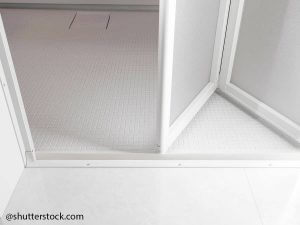
These doors do not fit into a concealed shell but collect on the side of the doorway. The panels of accordion doors can have a variable thickness, be completely smooth or have wood-like surfaces, and lack visible joints or welding points; they are composed of internal perimeter frames formed by special profiles in galvanised steel 20/10 thick or drummed steel, while the coating of the outer surface is made of smooth sheet 8/10 thick, first hot-dip galvanised and subsequently subjected to further treatments. The sliding system is similar to that of sliding doors, so the cleaning and lubrication actions to perform are the same as those already indicated. It can be useful to apply Long-Lasting Grease Spray along the hinges of the various door segments, which facilitates movement and keeps the joints clean.
Step 3: Lubricate overhead door
Overhead doors are a typical type of sliding door which can be manual or electrically powered. Regardless, they have several joints, rotation and lifting mechanisms. These are all usually fairly easy to reach. Preventive action may be required on these parts with WD-40 Specialist Fact-Acting Degreaser, which removes old grease that has been mixed with dust and other foreign bodies. Then lubricate with the Grease Spray.
Step 4: Lubricate the sliding guides of corners
Just like dual threshold door systems, sliding doors can be designed to meet in a corner at two heights. This allows sliding the doors backwards to reveal an open angle arrangement without any visible corner posts (models with static corner posts are also available). In these cases, it’s important to lubricate the track sliding guides in the same manner as described above.
To follow all the news of WD-40 Africa, follow us on Facebook and Instagram !

