


Those who love fishing know how dirty fishing reels and rods can get. Soil, bait residues, salt and water are deteriorating agents which can cause serious damage to the equipment if underestimated. Good maintenance is essential: both routine maintenance after fishing and extraordinary maintenance at the end of the season.
Fishing reel maintenance
Reels are robust and resistant mechanisms, but they have numerous mechanical elements, joints, gears, bushings etc. The two main enemies are the dirt that creeps in where it shouldn’t and salt, for those who fish at sea.
After each “catch”, it’s important to pass a microfibre cloth moistened with a little water over the outside of the reel. This is normally sufficient for regular use.
Every three to four uses it’s best to follow this cleaning with a light lubrication of the external moving parts, after having removed the coil with the wire. This is especially true for the joint of the bow, the crank and its gears, and the central shaft that drives the coil.
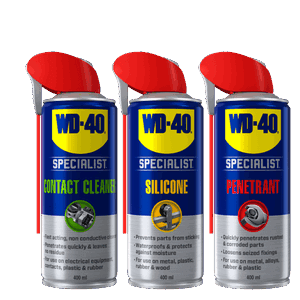
We suggest using WD-40 Specialist Water Resistant Silicone Lubricant, which has excellent lubricating properties, in order to ensure perfect movement of the parts. It provides excellent lubrication and protects against moisture after quickly drying. Its formula is compatible with all metals, plastics, rubber and wood.
If you are an expert (but only in this case), every two or three seasons it can also be useful to lubricate inside the fishing reel, opening it carefully. Note how the internal mechanisms are already slightly greased (usually with specific grease for reels). You can replenish the greasing by adding a little bit of WD-40 Specialist Dirt and Dust Resistant Dry Lube PTFE, which reduces friction and wear on the mechanisms.
Fishing rod maintenance
Just like the reel, water is the best thing to use for routinely cleaning fishing rods: pass a moistened microfibre cloth over the entire body of the rod and on its rings, then dry with a dry cloth. This step is always necessary after fishing at sea, as the water releases salt which interferes with the grafts of the various segments.
At the end of the season (but also during it), it’s best to add further lubrication using WD-40 Specialist Dirt & Dust Resistant Dry Lube PTFE Spray, which provides excellent lubrication and protection by reducing friction and is ideal for components or mechanisms exposed to water.
It is advisable to carry out this application by spraying a little product on a microfibre cloth that is then passed over the entire rod and the rings. Then pass over everything again using paper towels to remove any excess.
Finally, a tip: it is advisable to always have a “freezing” spray can with you when fishing, the type used to eliminate issues when the body is struck. Its use is necessary when the joints of the carbon rod sections cannot be moved: a spray of this solves the problem.
To follow all the news of WD-40 Africa, follow us on Facebook and Instagram !

